The Education Value Chain: Where AI Fits
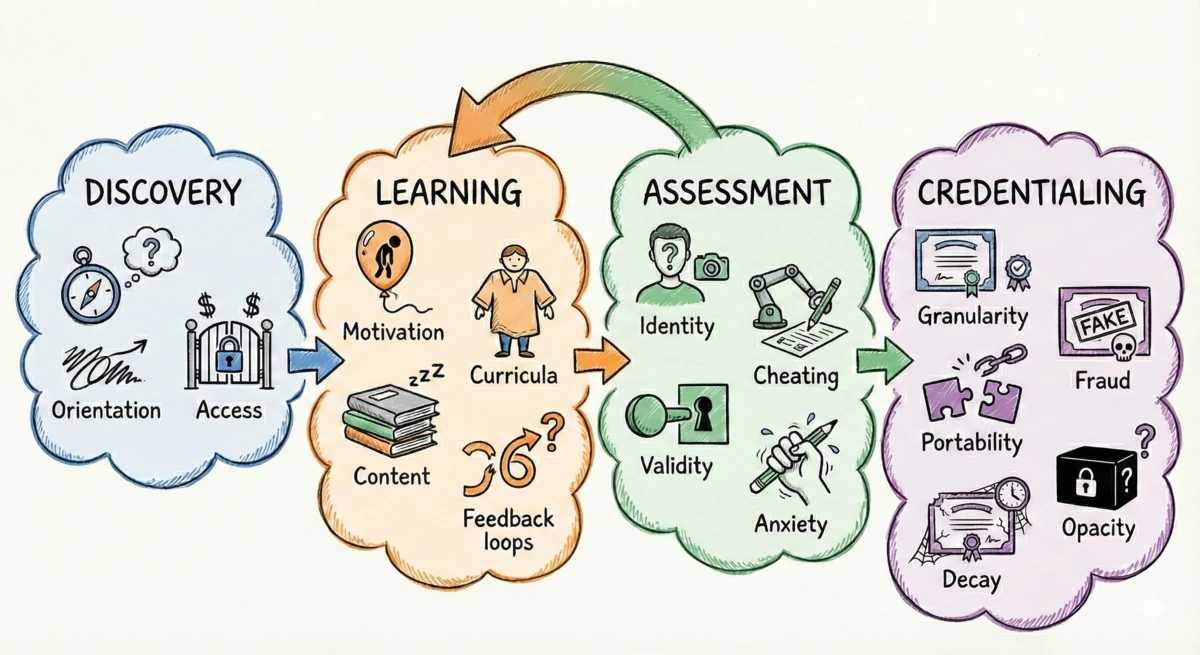
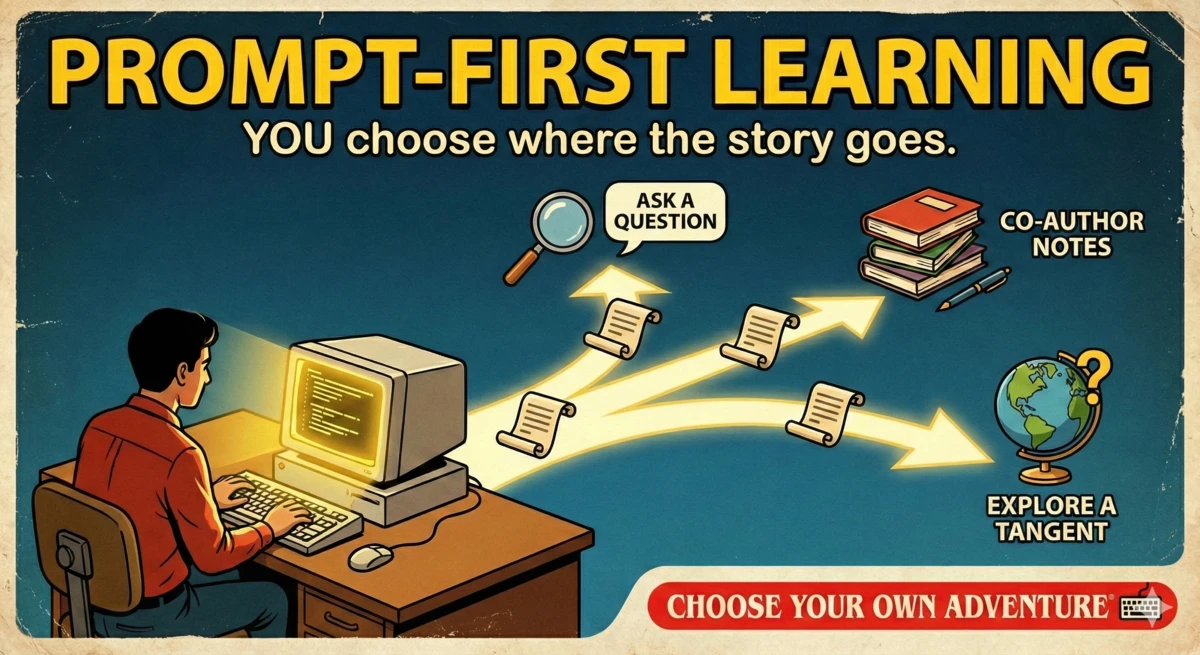
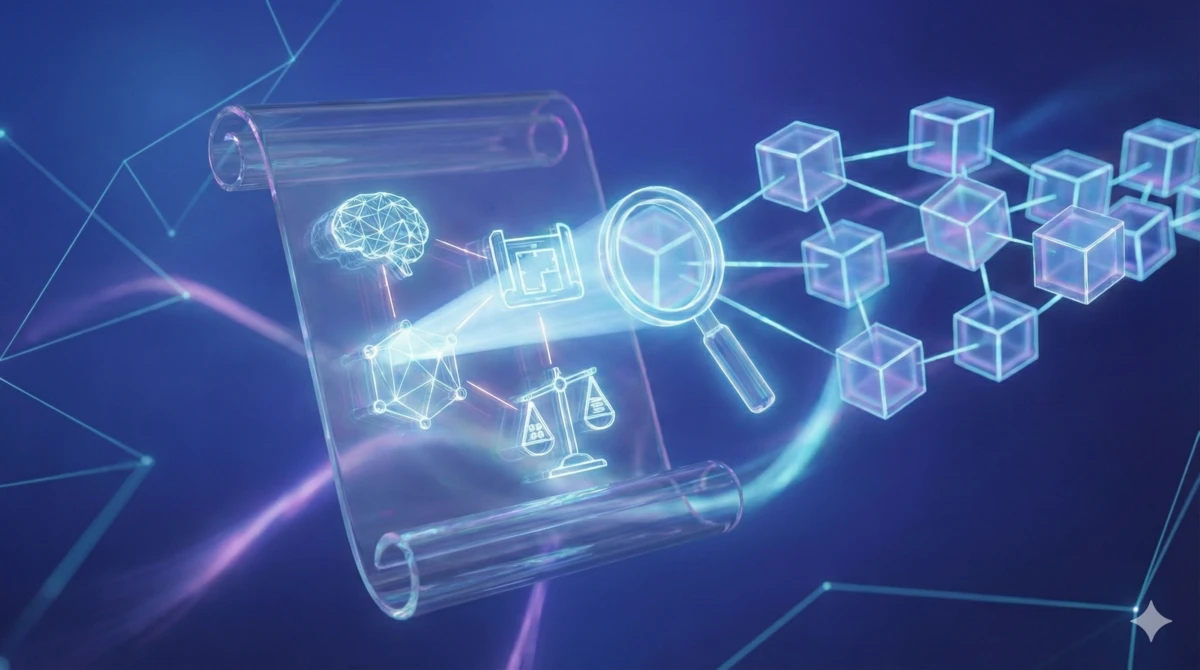
Education isn't one thing. Decomposing it into stages reveals where technology can actually help. On January 21, 2026, Google announced SAT practice tests inside Gemini (free, full-length, AI-graded). The same day, OpenAI launched Education for Countries at Davos, a program helping governments bring AI into their national education systems. Google's move is specific; OpenAI's is broader. Either way, AI in education is accelerating. The question is where in education. "AI will transform education" is about as actionable as "software will fix business." A high schooler choosing between nursing and computer science has a different problem than a dev bootcamp student struggling with recursion, who has a different problem than a hiring manager trying to verify a candidate's credentials. Which part of education are we talking about? This post tries to answer that by decomposing education into stages, mapping what's broken at each, and sketching where technology could intervene. Education, viewed from the learner's perspective, is a four-stage value chain. Each stage answers a different question: Similar stage-based models exist in professional certification and learning science,1 but none were simple enough to use off the shelf, so I built this one. I've pressure-tested it with teachers and professors, and it holds up. Consider a working professional pivoting from marketing to data science. She starts at Discovery: researching which skills matter, comparing programs, reading job postings to understand what employers actually want. She moves to Learning: working through a curriculum, building projects, filling gaps in statistics and Python. Then Assessment: taking practice tests, submitting portfolio projects for feedback, measuring herself against job requirements. Finally, Credentialing: earning a certification, building a public portfolio, getting a reference from a mentor. Each stage has different failure modes and different opportunities for technology to help. These stages are sequential but not strictly linear. A student might cycle between Learning and Assessment many times before reaching Credentialing. Or she might loop from Learning back to Discovery entirely: halfway through a data science curriculum, she encounters computer vision and realizes that's the subfield she actually wants to pursue. The value chain describes the logical progression, not a rigid pipeline. Each stage breaks in its own way. Here's what learners, educators, and employers might run into. Below are fifteen pain points across the four stages, each with a one-line summary. Not exhaustive, but it follows the 80/20 rule: Without a map, you might build a better textbook. That's an improvement, but if credentialing is the actual bottleneck, it's not the highest-leverage one. The stages force you to see all the pieces and ask: where does improvement matter most? Now that we have the stages and their pain points, we can ask: what would it look like if we pointed current AI capabilities and other emerging technologies at each one? What follows are thought experiments (one per stage), not validated solutions. Current AI agents can already query databases, parse documents, and write analysis code. A pathfinding agent would combine these for career planning: you upload your resume and transcripts, and the AI cross-references them against job postings and skill frameworks to map where you could go. Invest six months in statistics and data infrastructure, and it sketches how your options shift; pivot to UX instead, and the picture changes. The three-dimensional discovery problem (interest, aptitude, demand) becomes a navigable decision space. Large language models can already hold extended, context-aware conversations and adapt their explanations on the fly. A prompt-first learning system would make that conversation the path, much more than a supplement for when you're stuck. You ask about the parts that confuse you, push back when something doesn't click, and the material reshapes itself in real-time. The end artifact is co-authored study notes shaped by your specific gaps, questions, and journey. I wrote about this in more detail in Prompt-First Learning. Today's models are multimodal: they can process text, images, and video, and interpret what you're doing through a screen or a camera. An AI-assessed performance system would use this to replace exams with task simulations. Instead of answering questions about circuit design, you design and route a circuit board while the AI evaluates your component choices and trace layout. Instead of writing about project management principles, you work through a scenario while the AI evaluates your decisions. Every learner's task unfolds differently based on their choices, making certain forms of cheating significantly harder. What you're assessed on is closer to what you'd do on the job. Blockchain can make any record instantly verifiable and tamper-proof. An evidence-anchored credentialing system would go further: the chain stores not just the claim ("this person passed") but hashes of what was actually demonstrated — assessment responses, project artifacts, evaluator scores. The credential becomes a transparent container rather than an opaque badge. Anyone verifying it can audit the evidence behind it, shifting trust from issuer reputation to verifiable proof. This addresses fraud (credentials can't be forged), portability (anyone can verify without contacting the issuer), and opacity (the evidence is auditable). Many actors participate across these stages, each with different incentives and constraints: Future posts will pick a stage, consider these actors in context, and dig into the most pressing pain points and the most promising uses of technology within that stage. This is a starting framework. It may be missing a piece or two, or the boundaries may shift as I dig deeper. If you see a gap, let me know. The closest parallels are the learn-practice-certify progression common in professional certification and the seven-step transformative learning cycle from De Witt et al. (2023). ↩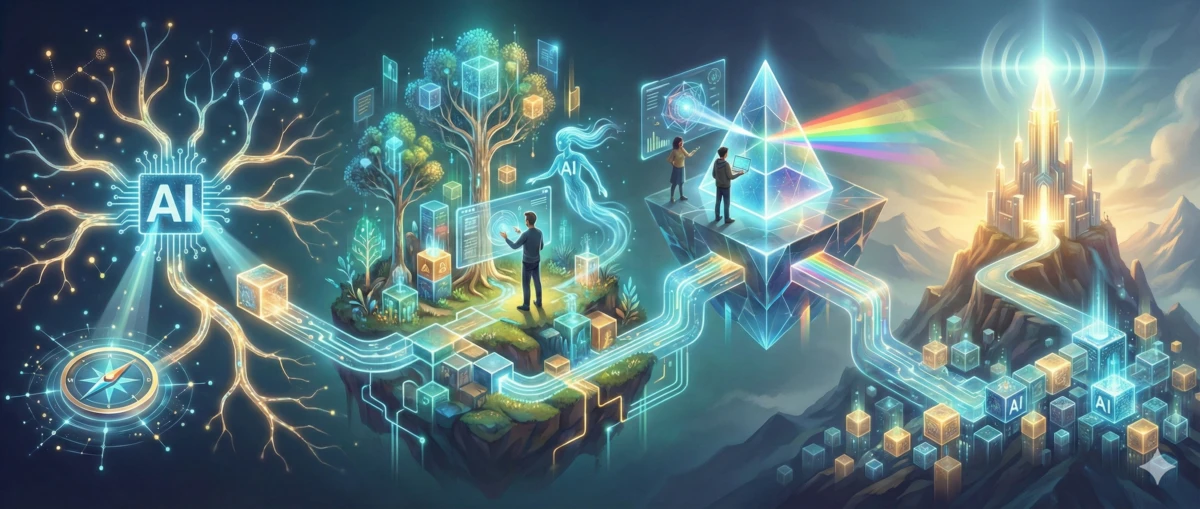
The Value Chain
Stage Function Core Question Discovery Identify what to pursue What should I learn? Learning Acquire knowledge and skills How do I learn it? Assessment Measure what was learned Did I learn it? Credentialing Signal competence to others How do I prove it? What's Broken: Stage by Stage
Discovery
Learning
Assessment
Credentialing
Putting the Stages to Work
Discovery: Career Pathfinding Agent

Learning: Prompt-First Learning
Assessment: AI-assessed Performance

Credentialing: Evidence-Anchored Credentials
What's Next
This post was written in collaboration with Claude.